Elite Scales & Systems · Outlast Crane Co. · ScaleTex MFG
Brand, website, and operations work across three businesses.
Our work with Elite Scales, Outlast Crane, and ScaleTex spans brand strategy, websites, and Elite’s service operations, including scheduling and billing-review requirements.
Brand strategy · website development · operations consulting
- Engagement
- Brand, digital experience
& operations consulting - Market
- Industrial equipment
& field services · Texas - Project record
- 2026 · ongoing engagement
- Current stage
- Outlast website live
Elite & ScaleTex in prototype
The challenge
What each business needed
Elite’s service customers, Outlast’s crane buyers, and ScaleTex’s weighing-product buyers needed distinct paths. Elite also needed a service process that could adapt to urgent calls without losing track of maintenance and billing.
Our responsibility
Bennu’s role
We developed positioning, website structure and content, and brand guidelines, alongside Elite’s process maps, software evaluation, draft procedures, and AI-assisted review requirements.
The work so far
Current progress
Outlast’s website is live. Elite and ScaleTex have navigable prototypes. Three service-workflow scenarios and twelve billing checks give the team a defined basis for its next implementation phase.
02 / Three brands, three buyer journeys
A website approach for each business.
Elite Scales & Systems
Separate paths for service requests and equipment inquiries.
For Elite, we developed service positioning, a website strategy, and a navigable website prototype around the reasons customers make contact: a scale is down, calibration is due, or equipment needs to be bought, rented, or upgraded.
The prototype turns those needs into separate paths, supported by service and equipment pages, a visible emergency contact route, maintenance content, and inquiry forms. The strategy also covers local search, business-profile consistency, reviews, and the information needed at intake.
The inquiry paths also informed the service-process work: what information to collect, how to prioritize a request, and who should handle it.
Explore the Elite prototype (opens in a new tab)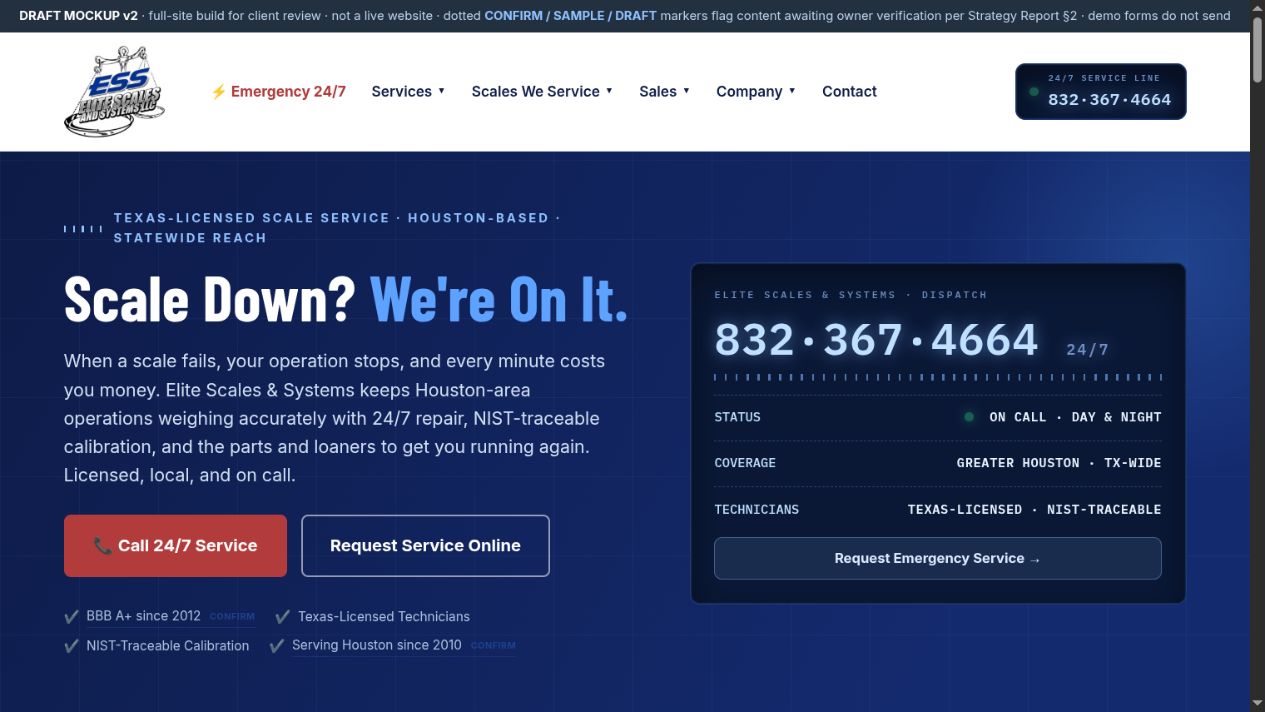
Outlast Crane Co.
Help buyers compare equipment and discuss their application.
Outlast began with a launch strategy anchored in the TKA 8800 service crane. We developed positioning, messaging, visual standards, website architecture, product content, and plans for trade-show and dealer follow-up. The visual guide established how the supplied identity would carry through typography, color, technical data, and website presentation.
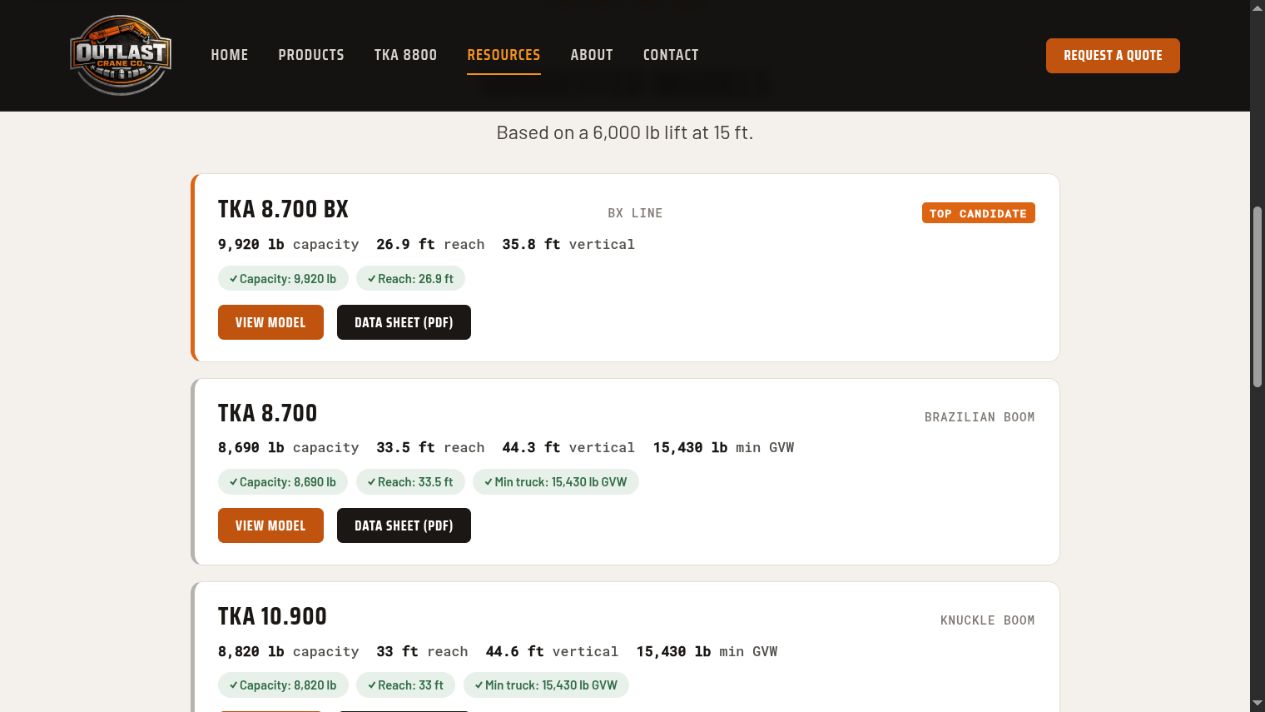
The website work expanded into a broader product experience: catalog browsing, detailed model pages, industry applications, downloadable data sheets, product comparison, and Outlast Match. The selector asks about the work, load, reach, and truck, then presents a preliminary shortlist for a fitment conversation.
Buyers can include product and application details when making an inquiry. Final suitability still requires a load-chart and fitment review.
Explore the live Outlast website (opens in a new tab)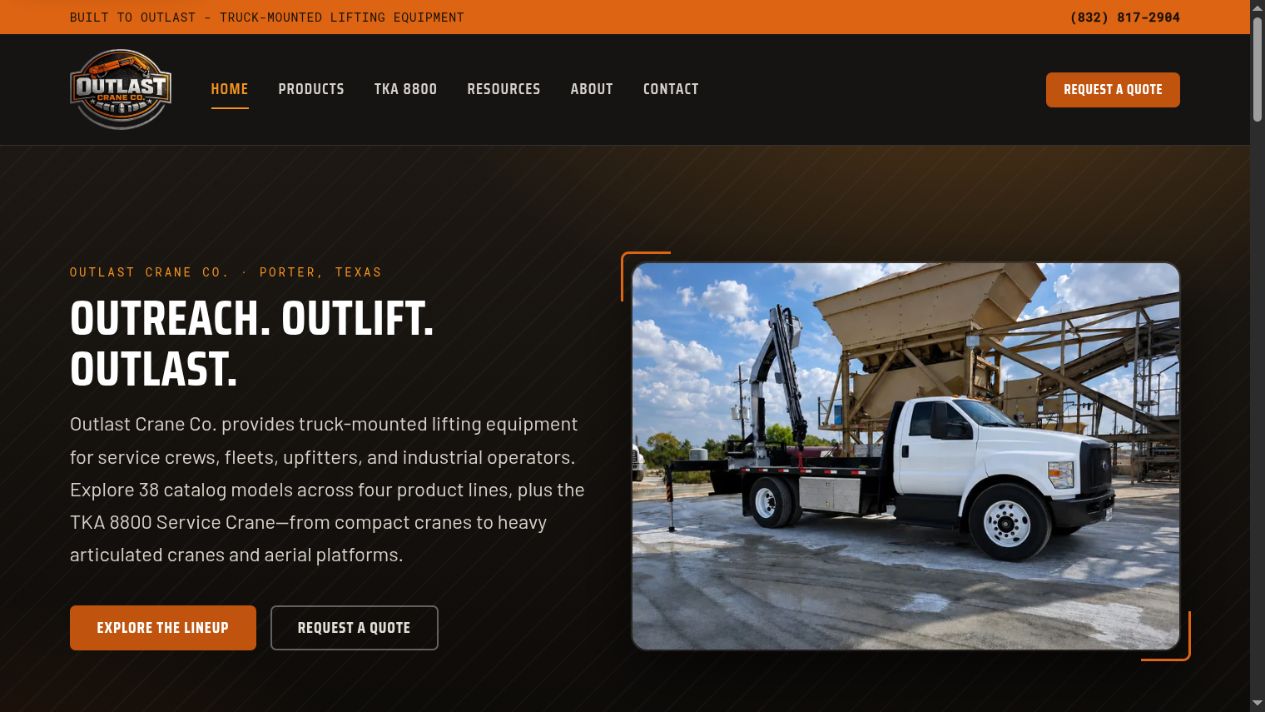
Inside the Outlast experience
Keep the application details with the inquiry
Outlast Match asks about the task, load, reach, and truck. The result carries those selections into an application inquiry, giving the fitment conversation a more useful starting point.
Actual interface with sample inputs. The shortlist is preliminary; final suitability requires load-chart and fitment review.
ScaleTex MFG
Present the wider range of weighing products.
ScaleTex’s early strategy centered on the TP Series truck scale. The subsequent website revision broadened the positioning to industrial weighing products, including truck, floor, portable, steel-deck, and concrete-deck scale options.
We developed visual and verbal brand guidelines, product messaging, a product-led navigation structure, and a 20-page website prototype. Buyer guides and comparisons sit alongside the products they explain. A dealer and support-network section gives partners and customers a distinct route, while the quote form covers a wider range of products and inquiry types.
The site distinguishes ScaleTex’s products from the support arrangements around them. Product claims and coverage details remain marked for verification in the prototype.
Explore the ScaleTex prototype (opens in a new tab)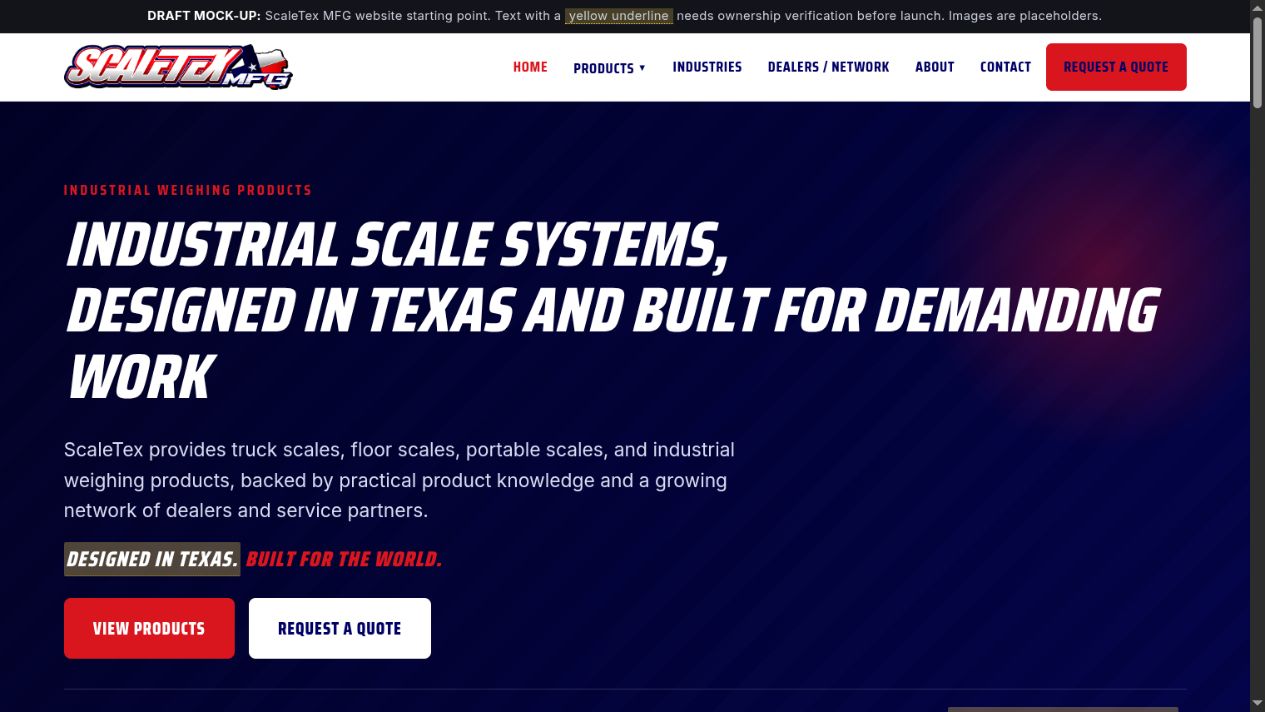
03 / The service operations work
Rescheduling maintenance when urgent work comes in.
Elite’s service schedule starts with preventive maintenance, then changes as higher-priority calls arrive. We documented the current process, designed an improved workflow using the existing tools, and mapped a separate future option around Method Field Services.
The proposed workflow defines five priority levels, rules for moving maintenance, certification deadlines, technician closeout requirements, and billing review.
When an urgent call displaces maintenance, the proposed process requires a new date, a reason for the move, and a deferral count. Repeated deferrals and approaching certification deadlines are flagged for management.
- 01
Plan the week
Maintenance visits, certification due dates, technician capacity.
- 02
Triage the call
Structured intake and a shared P1–P5 priority.
- 03
Approve the change
Protect deadlines. Track and re-date any displaced maintenance.
- 04
Capture the work
Labor, parts, notes, readings, photos, and signatures.
- 05
Review for billing
Clear missing details. A person approves the final record.
Weekly reporting feeds the next plan: due, completed, deferred, at risk, and ready to invoice.
01 / Current-state map
Documents how recurring maintenance, service calls, manual rescheduling, field capture, and billing currently connect. This establishes the starting point for decisions.
02 / Improve the existing tools
A detailed procedure manual and workflow design for Smart Service, iFleet, Smart Certs, QuickBooks Desktop Enterprise, and Google Workspace. This is the recommended near-term direction.
03 / Evaluate a future platform
A separate Method Field Services scenario, supported by a comparison of eight platform or architecture options. Selection and implementation depend on a structured demo and pilot.
The deliverables are process maps, evaluation materials, and a draft operating manual. They document the design; adoption and production automation are separate stages.
04 / AI with a defined job
Make billing exceptions easier to review.
The client supplied 12 checks for completed Smart Service work orders. We organized the requirements by the issue to detect, the records needed to check it, and the person responsible for a correction.
Complete, readable work orders. Missing work orders, labor-line order, and clear descriptions of the service performed.
Parts and associated charges. Parts mentioned in notes, matching job items, customer pricing history, and freight review.
Travel-related charges. Mileage and fuel-surcharge checks against the relevant job, vehicle, and approved rate information.
Maintenance billing. Historical calibration or maintenance pricing and required service-related line items.
Record consistency. Date discrepancies and customer exemption information flagged for review against approved records.
The proposed starting point is hands-on review of exported data: AI prepares clearer notes, exception lists, and summaries; the team reviews and applies approved corrections. Automated changes inside operational or accounting systems are a later implementation decision.
The manual describes how reviewed staff corrections can be used as approved examples for later drafts.
Current stage: review requirements and implementation approach defined. A team pilot will establish accuracy, review effort, and readiness for further automation.
05 / The supporting work
Related planning and recommendations.
The engagement also covered software choices, phone routing, file storage, and marketing plans. These recommendations support the next implementation phase.
Software and data decisions
The platform evaluation and comparison workbook assess options against Elite’s requirement to retain QuickBooks Desktop Enterprise and Google Workspace. The recommendation starts with improving the existing service tools and validating a future platform through a pilot.
Phone and inquiry routing
The strategies define distinct routes for service requests, product quotes, dealer inquiries, and support. RingCentral and CRM recommendations address ownership and follow-up; the record supports planning, with deployment still to be confirmed.
Files, storage, and resilience
The broader infrastructure scope includes file organization and a procurement plan for primary network storage, an off-site backup target, and network improvements. These are documented planning deliverables.
Marketing and sales enablement
Brand-specific strategies cover search, educational content, product resources, lead qualification, dealer development, and launch follow-up. The next phase calls for selecting each company’s marketing priorities and turning those choices into an execution plan.
06 / What the work has produced
Deliverables and current status.
The deliverables include brand guidelines, websites and prototypes, process maps, a draft procedure manual, software evaluations, and AI review requirements.
- Brands addressed
- 3
- Workflow scenarios mapped
- 3
- Platform options evaluated
- 8
- Billing checks structured
- 12
Scroll across the table to read each deliverable’s current stage →
| Workstream | Evidence in hand | Current stage |
|---|---|---|
| Outlast website | Live product site, catalog, model information, selection and inquiry paths | Live site inspected |
| Elite website | Strategy and navigable service-led prototype | Prototype / completion phase |
| ScaleTex website | Broader product positioning and 20-page prototype | Prototype / completion phase |
| Service operations | Three workflow scenarios, platform evaluation, draft procedure manual | Design documented |
| AI-assisted review | Twelve billing checks and a phased, human-reviewed approach | Scope defined |
| Marketing & infrastructure | Brand-specific strategies, routing recommendations, storage procurement plan | Planning / staged execution |
Project status as of September 2026. The figures above describe delivered scope. Business performance measurement is part of the next phase.
The next phase
The next phase is to complete the Elite and ScaleTex sites, agree on marketing priorities, and pilot the service and billing-review process before adding further automation.
07 / Why this engagement matters
Connecting the website to the day-to-day work.
For these businesses, a website inquiry is the start of a longer process. Someone needs to respond, confirm the requirements, schedule the work, and make sure the completed job can be billed.
Bennu’s role has covered both the websites and those operational details. The case shows the work delivered so far and the decisions still needed to put the proposed processes into use.